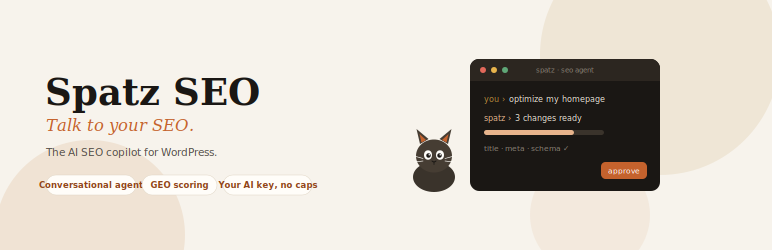
Spatz SEO is a WordPress plugin that replaces the traditional “fill in this field, toggle that switch” SEO workflow with a conversational AI agent. You describe what you want in plain English — “audit my homepage,” “add schema to my product pages,” “check what’s hurting my rankings” — and the agent figures out what to do, explains its reasoning, and asks for your approval before changing anything on your live site. That’s the core idea, and it’s a meaningful departure from every other SEO plugin in the WordPress ecosystem.
Why Traditional SEO Plugins Fall Short
Plugins like Yoast SEO and Rank Math are genuinely useful tools. They surface meta fields, run readability checks, and generate sitemaps. But they all share the same fundamental model: they give you a dashboard full of controls and expect you to know which ones to use, when, and why.
That model works fine if you already understand SEO. For most WordPress site owners — small business owners, bloggers, freelancers running client sites — it means either guessing your way through settings or spending hours on tutorials before you’ve improved a single page.
The gap between “the tool shows me a red dot” and “I know exactly what to fix and how” is where most SEO work actually stalls. Spatz SEO is designed to close that gap by making the tool itself capable of reasoning, not just reporting.
How the Conversational Agent Actually Works
When you install Spatz SEO, you connect it to your own Anthropic API key. Anthropic makes Claude, one of the most capable large language models available. The plugin uses that connection to power a chat interface that lives right inside your WordPress admin — no third-party dashboard, no separate app to log into.
You type a request or question. The agent reads your live site, pulls in the relevant data, and responds with a specific proposal: here’s what I found, here’s what I’d change, here’s why. You review it and approve or decline. Nothing ships without your sign-off.
This “propose before you change” model is important. Automated SEO tools that silently rewrite your content or metadata can cause real problems — pages that rank well can drop overnight if something goes wrong. Spatz SEO keeps you in control by design.
The bring-your-own-key approach also means your content and site data go directly to Anthropic under your own account, not through a third-party intermediary. You pay Anthropic directly for API usage, and Spatz SEO itself doesn’t sit between you and your data.
What Are the 56 Tools?
Under the hood, Spatz SEO gives the AI agent access to 56 distinct tools — specific capabilities it can call on when you ask it to do something. You never interact with these tools directly; they’re what enable the agent to take action rather than just give advice.
Those tools cover a wide range of SEO tasks:
- Site auditing — crawling your pages to identify issues like missing titles, thin content, broken internal links, or misconfigured canonical tags.
- Schema markup — generating and inserting structured data (the code that helps Google display rich results like star ratings, FAQs, and product prices in search results).
- Meta optimization — writing or rewriting title tags and meta descriptions for individual pages or in bulk.
- GEO scoring — measuring how well your content is optimized for generative engine optimization, meaning how likely it is to be cited or summarized by AI tools like ChatGPT and Google’s AI Overviews.
- Activity logging — keeping a record of every change the agent proposes and every action you approve, so you always know what was changed and when.
- WooCommerce and Easy Digital Downloads support — handling product-specific SEO for e-commerce sites, including product schema and category optimization.
The practical effect is that one natural-language request can trigger a sequence of tool calls in the background. Ask the agent to “optimize the SEO on my five most recent posts” and it will read each post, evaluate them, draft improvements, and present the proposed changes for your review — without you having to open each post individually.
What Is a GEO Score, and Why Does It Matter Now?
GEO stands for Generative Engine Optimization. It refers to how well your content is structured and written to be picked up and cited by AI-powered search tools — ChatGPT, Perplexity, Google’s AI Overviews, and others.
Traditional SEO focuses on ranking in the ten blue links. That still matters. But a growing share of people now get their answers directly from an AI summary, often without clicking through to any website at all. If your content isn’t cited in those summaries, you’re invisible to that audience.
GEO optimization is partly about structure (clear headings, direct answers near the top of the page, well-defined facts), partly about schema markup (giving search engines machine-readable context), and partly about authority signals. Spatz SEO’s GEO score gives you a concrete measure of where your content stands on these factors, so you know what to improve rather than guessing.
This is one of the clearest ways Spatz SEO differentiates itself from older plugins — most were built before generative AI search existed, and they don’t account for it at all.
Migrating from Yoast or Rank Math
Switching SEO plugins is one of the most anxiety-inducing tasks in WordPress. Your meta titles, descriptions, focus keywords, and schema settings all live inside your current plugin’s database tables. Move to a new plugin without migrating that data and you can lose years of carefully set metadata overnight.
Spatz SEO includes an import tool that pulls in your existing data from Yoast SEO or Rank Math. Your titles, descriptions, and other metadata carry over so you’re not starting from scratch. You can then let the agent audit what you’ve migrated and suggest improvements over time, rather than having to redo everything at once.
This makes it practical to try Spatz SEO on a site that already has SEO work invested in it, without the usual risk of a clean-slate switch.
Is Spatz SEO Right for Your Site?
Spatz SEO fits best if one or more of these describes you:
- You understand SEO at a conceptual level but spend too much time on the mechanical work of applying it post by post.
- You run a WooCommerce or EDD store and want product and category SEO handled without manual effort on every listing.
- You want to get ahead of AI search (GEO) rather than only optimizing for traditional rankings.
- You’ve outgrown the “red/orange/green dot” feedback model and want to understand the reasoning behind recommendations.
- You want a clear audit trail of every SEO change made to your site.
It’s less likely to be the right fit if you genuinely prefer hands-on control over every individual setting, or if you’re running a very simple site with minimal content where a lightweight free plugin covers your needs completely.
The bring-your-own-Anthropic-key model is worth factoring in too. You’ll pay Anthropic for API usage based on how much you use the agent — frequent, large-scale audits on a big site will cost more than occasional queries on a smaller one. For most sites, this usage-based pricing ends up being more economical than a flat monthly subscription to a premium SEO platform, but it’s worth being aware of upfront.
The Bottom Line
Most SEO plugins give you more information. Spatz SEO gives you an agent that can act on that information — with your approval, with clear reasoning, and with a full record of what changed. If you’ve ever stared at an SEO dashboard knowing something needs to be fixed but not quite sure where to start, that’s exactly the gap it’s built to fill.
The combination of a conversational interface, 56 actionable tools, GEO scoring, and solid e-commerce support makes it a genuinely different kind of plugin — not just a smarter Yoast, but a different approach to how SEO work gets done on a WordPress site.